
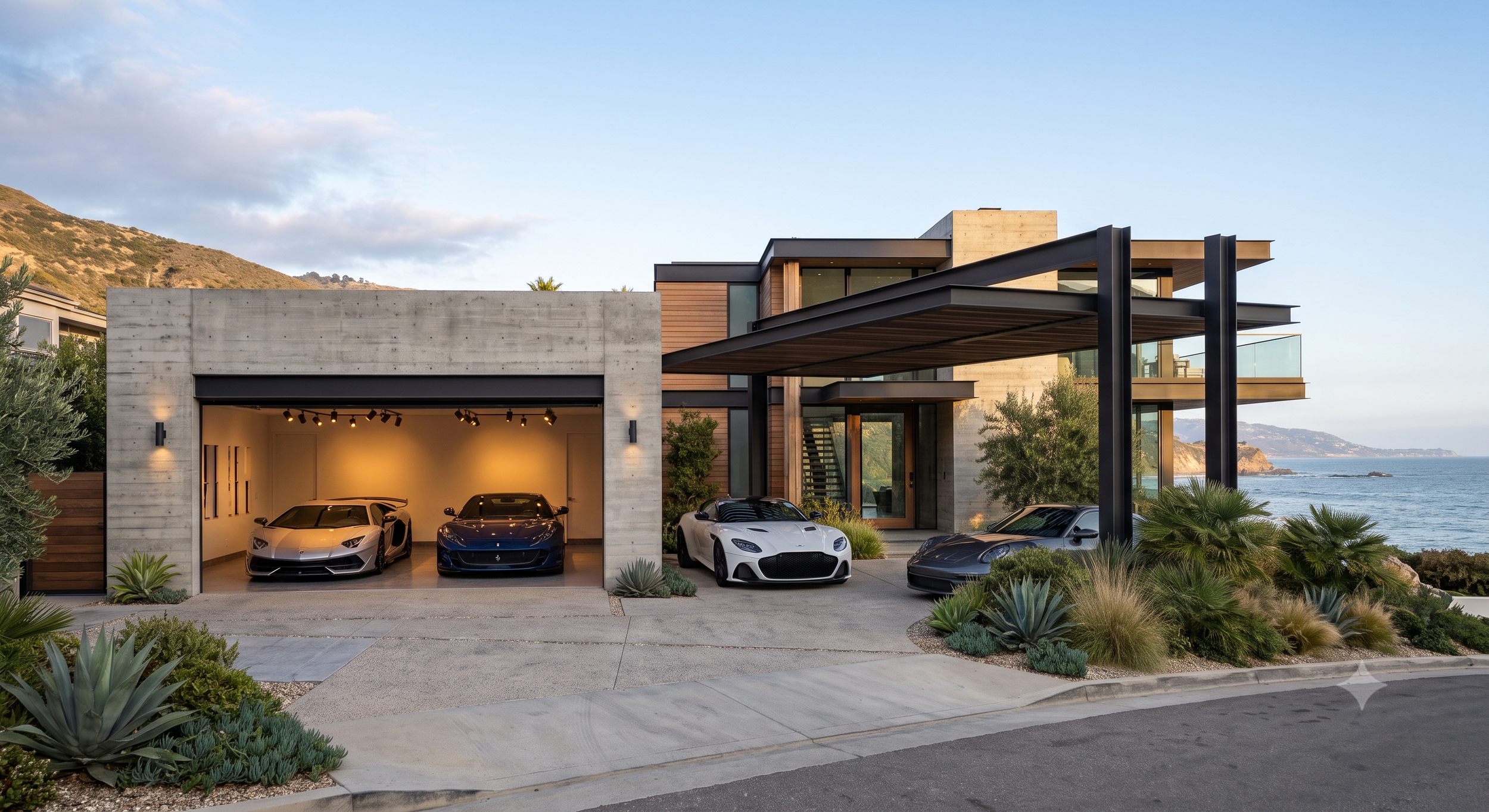
THE MID-CENTURY ALREADY SOLVED YOUR SUMMER GARAGE PROBLEM.
Why the car you drive and the car you collect need completely different shelter
Drive through any mid-century neighborhood and you'll still spot them: the cantilevered carport floating over the driveway, a breezeblock screen throwing dappled light across the wall. Gorgeous, and once everywhere. Then, sometime in the last few decades, they quietly vanished. What happened?
Nothing about them stopped working. We wanted enclosed storage and better resale — and once air conditioning got cheap, we stopped needing to be clever. We sealed everything behind one big insulated door and machined our way out of the heat. We didn't outgrow the carport. We just got well-powered and a little lazy.
Which is a shame, because the carport was quietly brilliant — never a budget compromise, but a climate strategy. An open, roofed structure shades a car from the sun while letting air move freely, so it never bakes in a sealed heat-trap. Breezeblock did triple duty: shade, airflow, and privacy, all at once.
For a collector, it also solves a specific problem. Everyone runs out of enclosed space before they run out of cars, so the daily driver gets exiled to the driveway to bake and fade, or steals a bay a real car should have. A carport fixes the math — the cheapest protective square foot you can build, a roof and posts instead of walls and insulation. Get the everyday car under shade and you free a conditioned bay for something that's earned it. The daily driver doesn't need climate control anyway; it needs shade, airflow, and a roof.
The collectible is a different animal. The car whose condition is its value can't live in the open — but an enclosed garage isn't automatically a safe one. A sealed, uninsulated box bakes, swinging forty degrees between night and noon, and that constant expansion and contraction punishes leather, rubber, fluids, and seals. Enclosing the car isn't enough. You have to condition it.
For that, I recommend a variable-speed air conditioner that runs quietly around the clock. A conventional unit is a light switch — full blast, overshoot, shut off — loud, wasteful, and letting the air go still between cycles. A variable-speed system barely stops, adjusting its output a fifth at a time to hold a steady setpoint and keep air gently moving, so no stagnant pockets form where heat and moisture settle. And the real villain isn't heat — it's humidity. A unit that runs low and constant pulls moisture from the air far better than one that runs hard and intermittent, and moisture is what rusts a chassis, mildews leather, and cracks interiors. That it also runs cheaper is just the bonus.
So bring the carport back for the car you drive, and give the collectible the conditioned vault it deserves. Match the shelter to the car — the old idea and the new one, each doing what it's actually good at.
So bring the carport back for the car you drive, and give the collectible the conditioned vault it deserves. Match the shelter to the car — the old idea and the new one, each doing what it's actually good at.
Page Sigband is the founder of Joyride Garage Design, a specialty studio dedicated to luxury automotive environments and private collector spaces.