
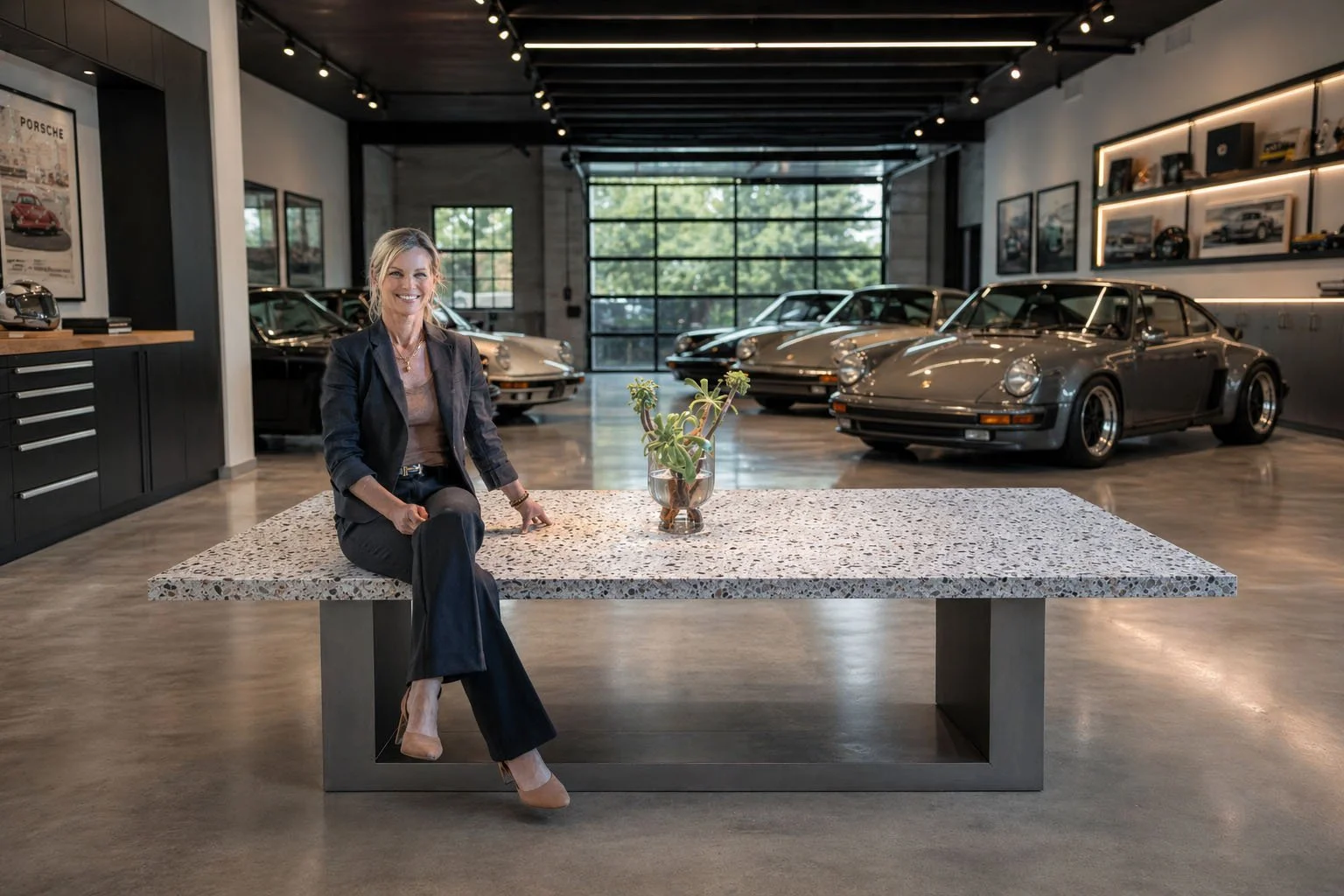
A Discipline of Its Own
People ask me, in some form or another, on almost every project: What is it, exactly, that you do?
Fair question. The work I do for car collectors doesn't fit neatly into the usual boxes, and I've spent a long time finding language for it.
Here's the shortest version: I'm not an architect. I'm not a stylist. I'm the person who designs the experience of the space.
That's a discipline of its own — and it's worth a few minutes to explain.
It's Not Decoration
When most people picture an interior designer, they picture someone choosing finishes. Paint, tile, the right sofa. That's part of the job, and good decoration takes more taste than people give it credit for.
But for a serious collection, decoration is the last layer of a much deeper process. Not the process itself.
A car collection isn't a room with cars in it. It's a curated environment, built around the emotional logic of what someone has spent a lifetime assembling. The cars are the protagonists. Everything else — proportions, sight lines, lighting, the order you encounter things in — exists in service of them.
Defining the Experience
The work starts with the collection itself. What does this client love? Is this personal, assembled over decades? Or a curatorial thesis about a particular era or marque?
Which cars should you see first? Which ones deserve a moment alone?
Out of those questions comes a design brief — a clear articulation of what the space is actually for, beyond its square footage. That brief drives everything downstream.
Space Planning Is Design Work
Here's the part most people misunderstand: I do space planning. I draw plans. I recommend wall placement. I shape the interior of the room so the collection has somewhere to live, and a sequence in which to be encountered.
I'm not an interior architect. When a project needs one, I work alongside them.
But where the walls go is a design decision, not just a structural one. The flow of a space — what you see first, what's revealed as you move, what's framed and what's held back — is the foundation everything else gets built on.
That decision belongs to the person designing the experience, in concert with the person engineering the structure. Done in that order, the architecture and the experience reinforce each other. Done out of order, the experiential design becomes a retrofit.
Then Comes Everything Else
Once the spatial framework is right, the rest goes to work.
Lighting that sculpts metal instead of just lighting a room. Materials that frame the cars without competing with them. The layered details — seating, bar, lounge, workshop, library — where the personal lives alongside the curatorial.
That last layer is the part that looks like traditional interior design. It's also the final layer, not the first.
Why It Matters
A lot of people fall into the trap of calling the designer in after all the construction has been done. This is a mistake.
If you do this, your project is essentially a retrofit. The walls are already where they are. The lighting is already roughed in. The sight lines are already set. By the time the designer walks in, the most important decisions have already been made — usually by people who weren't thinking about how the collection would be experienced.
The result is a space that photographs beautifully and feels strangely lifeless to be inside. The cars are there, but they aren't quite the point. The room has been arranged around them, but it hasn't been designed for them.
What I do sits earlier in the sequence. It pulls from interior design, museum exhibit design, furniture design, graphic design — whatever the project calls for. Twenty-six years of learning how environments shape the way people experience the things they love most.
A Word on the Team
Here's the other trap worth naming: builders who claim to be design/build, or architects who say they can handle the interiors too.
Be careful. No one is really good at both.
I say this with respect for both disciplines. Architects are trained to solve structural and spatial problems at the scale of a building. Builders are trained to execute. Designers are trained to think about how a space feels — how people move through it, what they notice, what shapes the experience. These are three different muscles, developed over years of dedicated practice. The Venn diagram has some overlap, but the center of each circle is its own territory.
When one discipline tries to absorb the others, something gets thinned out. Usually it's the experiential layer, because it's the easiest to underestimate from the outside.
The better model is to assemble a diverse team early — architect, designer, builder, and any specialty consultants — and give each person a voice at the table from the start. Decisions get sharper. The disciplines check and inform each other. And the client ends up with a space that reflects the best thinking of multiple experts, rather than the stretched bandwidth of one.
So What Do I Call This?
The shorthand is interior design for car collectors. The more accurate name is curatorial environment design — design work that treats the collection as the subject and the space as the frame.
It lives alongside architecture, not after it. It's what gives a collector environment a soul.
Not architecture. Not styling. Something of its own.
Page Sigband is the founder of Joyride Garage Design, a specialty studio dedicated to luxury automotive environments and private collector spaces.