
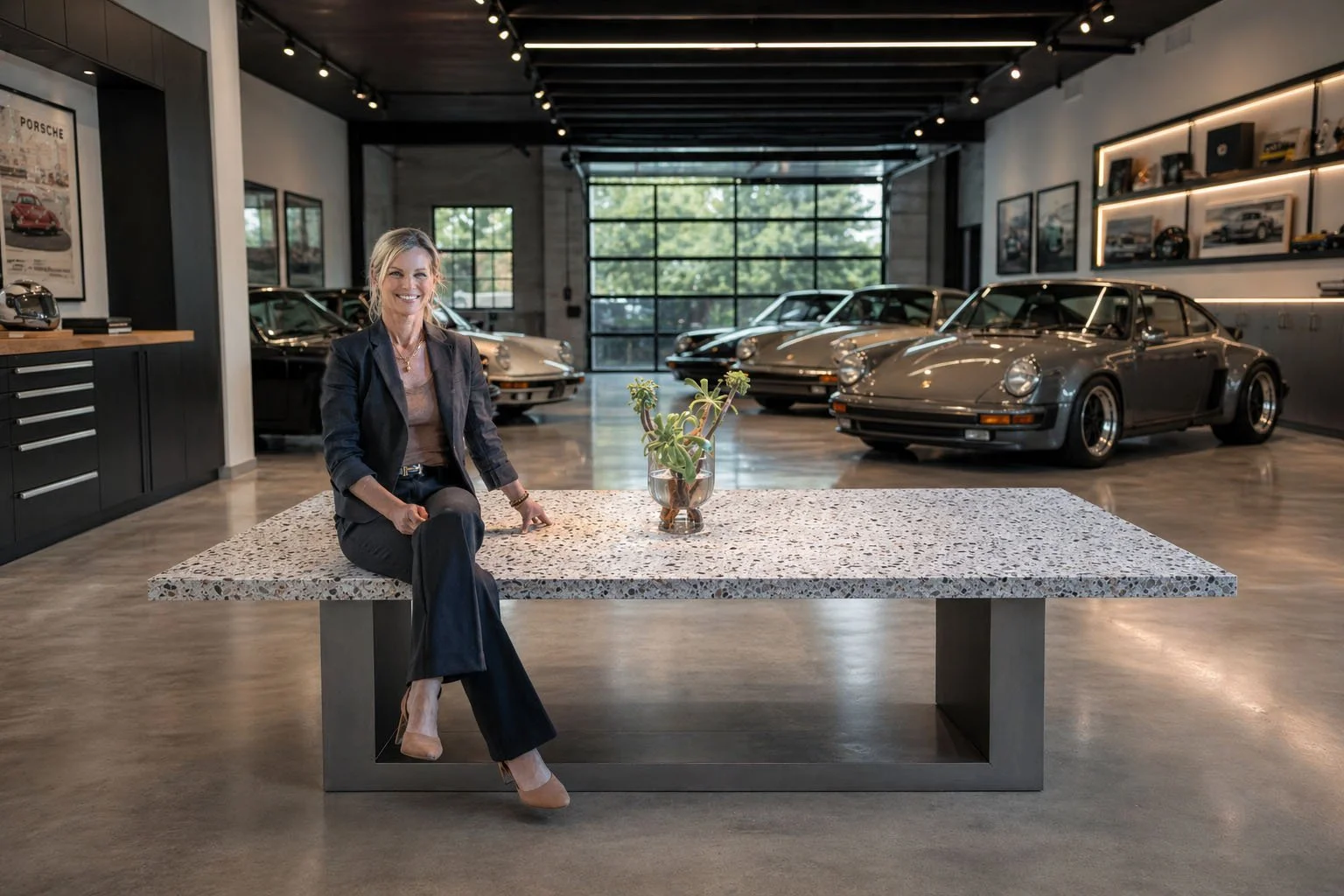
What I Actually Do (And Why It Isn't Decoration)
There's a conversation that happens, sometimes politely and sometimes not, on nearly every project I take on. A client describes the space they want built. An architect describes the structure. A contractor describes the cost. And somewhere in the middle of that conversation, someone gestures vaguely in my direction and says, "…and then Page comes in at the end to style it."
I'd like to clear something up.
The Word "Decoration" Is Doing a Lot of Work
When most people picture an interior designer, they picture someone choosing finishes. Paint colors. Tile. The right sofa. That is part of what interior design consists of, and good decoration takes more taste and discipline than most people give it credit for.
But decoration is not what I do for car collectors. And the gap between decorating a space and designing the experience of that space is where the work I actually care about lives.
A car collection is not a room with cars in it. It is a curated environment built around the emotional logic of what the collector has spent a lifetime assembling. The cars are the protagonists. Everything else — proportions, sight lines, lighting, materials, the sequence in which you encounter the collection, the way a person moves through the space — is design work. It isn't styling. It isn't the cherry on top of someone else's cake. It is the cake.
What This Looks Like in Practice
It starts with the collection. What does this client love? Is this a personal collection assembled over forty years, or a curatorial thesis about a particular era or marque? Are there cars here that should be encountered first, last, alone, or in dialogue with one another?
Then comes the spatial choreography — and this is where I want to be specific, because it's the part that's most often misunderstood. I do space planning. I recommend wall placement. I shape the interior architecture of the room so that the collection has somewhere to live and a sequence in which to be encountered. I am not an interior architect, and I work alongside one when the project calls for it. But the idea that the architect draws the walls and I show up later to pick the rug gets the order of operations exactly backwards. Where the walls go is a design decision, driven by how the collection should be experienced — and that decision belongs to the person designing the experience, in collaboration with the person engineering the structure.
From there: lighting that sculpts metal rather than simply illuminating a room. Materials that frame the cars without competing with them. The layered details — seating, bar, lounge, workshop, library — where the personal lives alongside the curatorial. That last layer is what looks most like traditional interior design. It is also the final layer, not the first.
Why the Distinction Matters
If the only design work in a collector environment is decoration applied at the end, you get a space that looks beautiful in photographs and feels strangely lifeless to be inside. The cars are present but they aren't the point. The room has been styled around them, but it has not been designed for them.
What I do sits upstream of that. It's the work of taking a collection, a client, and a building, and finding the spatial and design language that turns those three things into a single coherent environment. It draws on interior design, but also on museum exhibit design, furniture design, and graphic design — whatever the project requires. The training underneath it is not "I learned how to decorate." It's twenty-six years of learning how environments shape the way people experience the things they care about most.
So What Do I Call This?
I've called it interior design for car collectors, because that is the closest available shorthand. The more accurate description is curatorial environment design — design work that treats the collection as the subject and the space as the frame, and that thinks as much about narrative, sequence, and spatial flow as it does about finishes and furniture.
It is upstream of decoration, not downstream of it. It happens with the architect, not after the architect. It is what gives a collector environment a soul.
And the next time someone tells you it's styling, feel free to send them this.