
The Garage as Escape
Here's something I see all the time. A collector tours a friend's garage at the club, falls completely in love, and a few months later commissions one almost exactly like it — same flooring, same slatwall, same steel tool chests, same automotive-branded sign over the workbench. A bar along one wall, a sitting area in the corner, and if they're feeling ambitious, a racing simulator or a pool table. It's a handsome space. It's also the fourth one just like it on the row. (That's usually the tell that no designer was involved — just a template, copied.)
It makes sense, honestly. When you haven't seen what's possible, the most impressive thing you've come across becomes the blueprint. And added up — bar, lounge, a game or two — what most of these spaces amount to is a very nice gaming lounge that happens to have cars in it. Which is fine. But a private condo at a car club is something far rarer than a place to park. It's entirely yours — a destination you drive to on purpose, a space to disappear into for a few hours, surrounded by the machines that mean something. Your own little island, just off the coast of everyday life.
So here's the real question: why furnish your island to look exactly like the island three doors down?
And once you understand the garage that way — as a destination rather than a utility — everything about how it should feel starts to change. The goal stops being a nicer place to keep the cars and becomes something closer to a world you step into. An immersive environment. Somewhere that works on you the moment the door rises, often before you can explain why.
Forget every garage you've ever seen
Here's the part where I'd ask you to do something a little unnatural: forget every garage you've ever walked into. Not just your friend's — all of them. The whole vocabulary of what a garage is "supposed" to look like. Set it down for a minute.
Now imagine you've stepped onto a movie set instead.
The collection itself can be the story. A garage built around a fleet of Land Rovers doesn't have to look like a dealership — it can feel like an expedition base camp at the edge of a jungle, all canvas, brass, and the hum of somewhere far from home. A 1930s Duesenberg deserves more than a parking spot; picture a library wall that swings open on a hidden hinge into a Prohibition-era speakeasy, low light and good whiskey waiting on the other side.
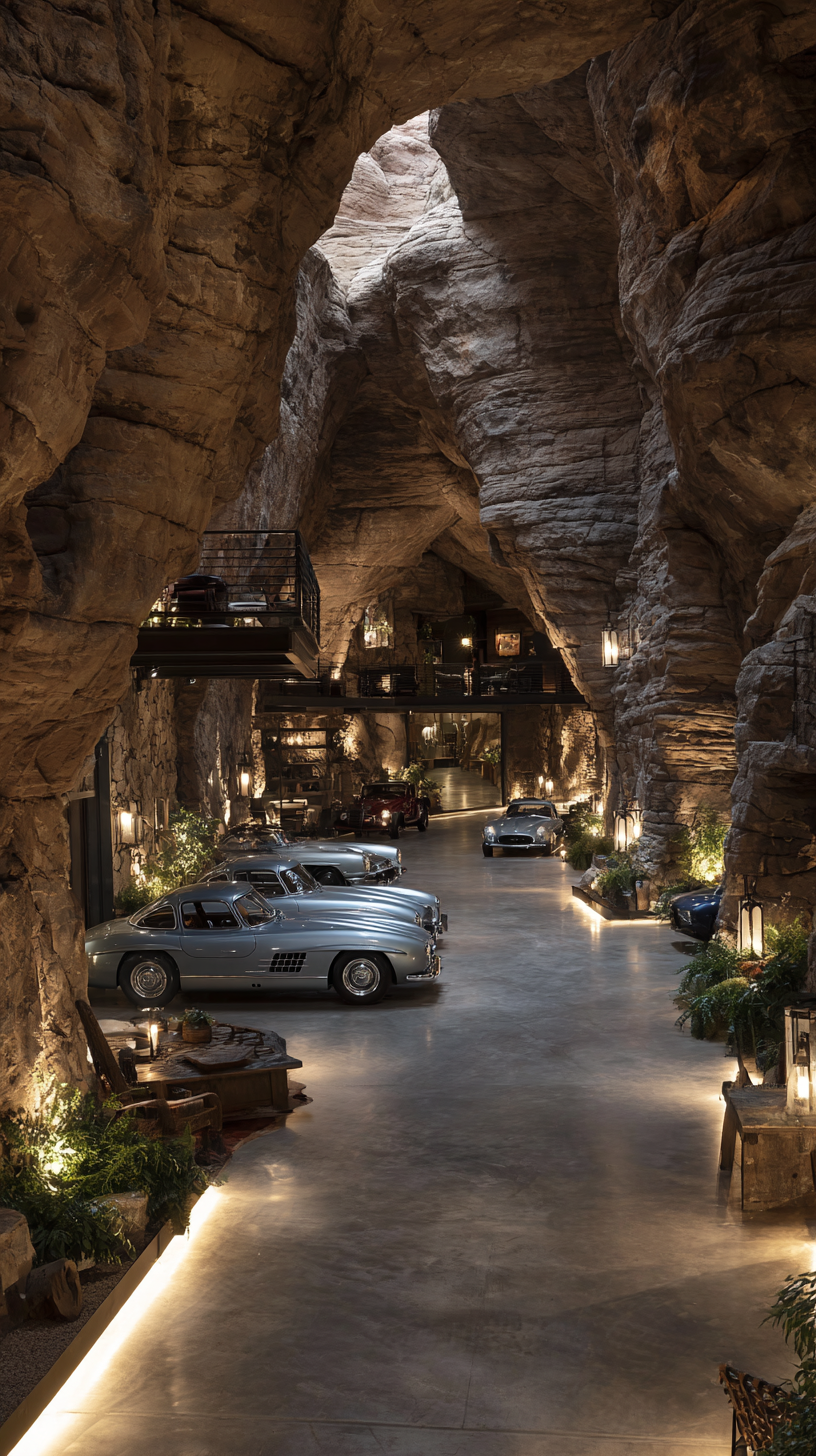
Or bring the whole thing underground. Picture a cave — walls of rough, textured stone, the light kept low and warm, the temperature dropping a few degrees the moment you step inside. The cars sit in the main chamber like relics in a dig, lit from below so the rock glows around them. From there, passages branch off into the stone. One tunnel opens onto a sauna, cedar benches and steam curling against the walls. Another runs deeper still, to a cold plunge as dark and quiet as an underground spring. It's the kind of silence you can feel in your chest — the whole world left up at street level, several feet above your head.
And a cave doesn't only run sideways. It climbs. These condos are tall — ceilings often run a full 25 feet — and unless you've put in a car lift, you're leaving a lot of functional vertical space on the table, dead air above the hoods. Run the stone straight up one full wall instead and it becomes a mountain face: real holds, a route to the rafters, crash pads waiting at the bottom. Now the space isn't only somewhere to unwind — it's somewhere to train. The same room where you disappear for an afternoon becomes the place you get your workout in: climb the wall, sweat it out in the sauna, shock it back to life in the plunge, all of it a few steps from the cars you built the room around. The garage as escape doesn't have to mean only the cars; it can mean everything a person needs to genuinely switch off — a place to move, to recover, to breathe, all without ever leaving the island.
Your island, your rules
The throughline in every one of these ideas is the same. These spaces work because they stop pretending to be garages and start being somewhere you'd want to be — a destination with a point of view, built around the things and feelings that matter to one specific person.
That's the real luxury. Not the square footage or the finishes, but the rare experience of walking through a door and feeling, immediately and completely, like you've left the rest of the world on the other side of it.
So the only question worth asking isn't what does a garage look like.
It's where do you want to go when you walk in?
Page Sigband is the founder of Joyride Garage Design, a specialty studio dedicated to luxury automotive environments and private collector spaces.