
BEAUTY CREATES ACCOUNTABILITY
Your garage is a disaster, and it isn't your fault.
Or rather — it's the room's fault first. Nobody designed it to be enjoyed. The fluorescent tubes throw the cold glare of a morgue or an interrogation room. The cabinets are particleboard pretending to be cabinetry. The hose sits coiled in the corner like it might strike. So you do the only sane thing a person can do in a space built to be tolerated rather than enjoyed: you drop your things and flee.
That's the whole problem, and almost no one names it correctly. We tell ourselves the garage became a catchall because we're disorganized, or busy, or just the kind of people who mean to deal with it someday. The truth is less flattering to the room and far kinder to us: an unwelcoming space doesn't invite care — it gives you permission to be careless. The flimsy shelf is practically asking to be buried. You aren't a slob. You're responding, accurately, to the message the room is sending: nothing here matters, so neither does what you do to it.
This is broken-windows theory, running quietly inside your own home. A neglected-looking space trains the people in it to neglect it further. The clutter isn't the disease. It's the symptom.
Which means the fix isn't a weekend of bins and label-makers. It's changing what the room asks of you — because the inverse is just as true, and far more powerful: beauty creates accountability. When a space is genuinely lovely, dropping a greasy bag on a beautiful surface suddenly feels like a small act of vandalism. You don't want to be the one who wrecks it. The room earns your respect, and respect is self-enforcing. That's the difference between discipline and environment. One is exhausting and doomed. The other simply makes care the path of least resistance.
So picture the room that does that.
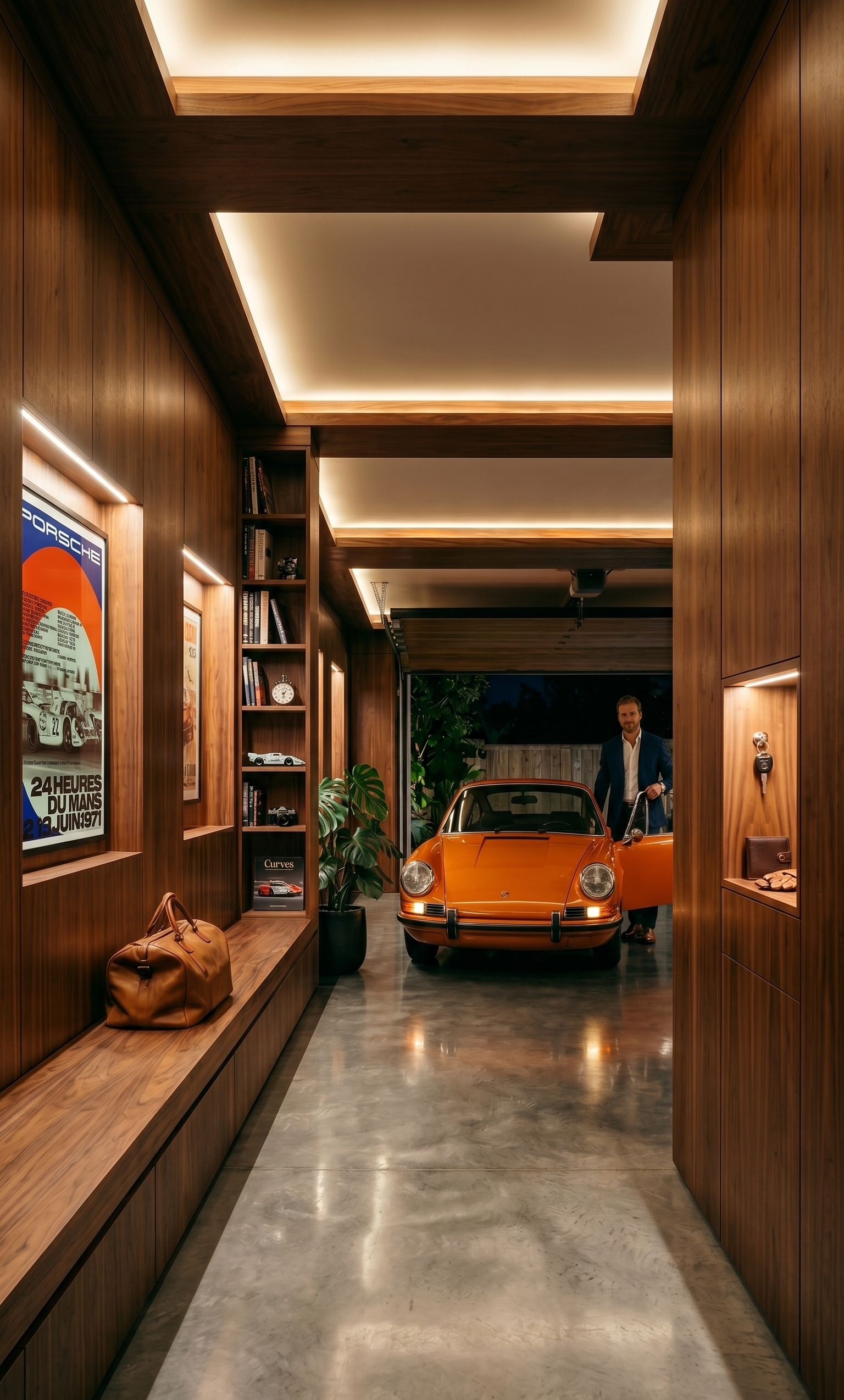
The door rolls up, and instead of that cold blue glare, you drive into warmth — low, calm light, the kind you'd find in a good library, not a laboratory. The walls are wood. The hard echo of concrete and metal is gone, hushed by surfaces chosen to absorb it. You've driven, unmistakably, into a room. The chaos is still there — ladder, tools, seasonal everything — present and entirely accessible, simply given the manners to stay out of sight. The cabinets don't read as cabinets; they read as paneling. The luxury isn't what's on display. It's everything that isn't.
And near the door to the house: a recessed nook, perfectly lit. A place to set down your keys, your wallet, and the day you just had. Because the garage is the threshold between your public self and your private one — the airlock between the version of you that just survived the freeway and the one about to walk in and be someone's parent, partner, calm. Most homes give you no buffer between those two people. This room gives you a breath.
Every other room has had its moment. Kitchens became showpieces, bathrooms became spas, even the laundry room got millwork. The garage — the room you pass through more than any other, every single day — got left behind with bare studs and a bad bulb. It's the last unconsidered room in the house. It doesn't have to be.
Make it beautiful, and you linger. You care. You keep it the way it deserves — not out of obligation, but because the room quietly raised the standard and you rose to meet it. The space that welcomes you is the space you protect.
A garage can be a place to store things. Or it can be the first room that greets you when you come home, and the last that lets you exhale before you do.
Beauty creates accountability. Build the room worth being accountable to.
Page Sigband is the founder of Joyride Garage Design, a specialty studio dedicated to luxury automotive environments and private collector spaces.